

Showing posts with label PICS. Show all posts
Showing posts with label PICS. Show all posts
Thursday, November 11, 2010


Friday, November 05, 2010
Tuesday, October 26, 2010
Red-crowned Barbet

Many birders have complained of the difficulty of finding the Red-crowned Barbet Megalaima rafflesii. I believe this is because most birders, including myself, seldom go birding in disturbed secondary forest where this is a common bird. On quite a few occasions, I have seen this barbet and also Blue-eared and Gold-whiskered barbets feeding on the ripe fruits of the Vitex (Verbenaceae) and other fruiting plants which are commonly found in secondary scrub.

Sunday, October 17, 2010

Friday, October 08, 2010
Friday, October 01, 2010
Saturday morning walks
Healthy Living Partnership Middlesex-London
Thames Valley Trail Association Inc.
SATURDAY MORNING WALKS
Each walk will begin at 9:00 a.m. from the meeting place listed below and will take approximately one hour. All walks are free. Come on out. Have lots of fun walking these beautiful trails and parks all within our City of London.
Families with children welcome. Except for the parks, the following trails will be too rugged for strollers. Wear good boots as there may be mud, roots or rocks. Please leave dogs at home. For more information call John Clark. 519-641-0442 p = Hilly trails
WINTER 2010/11 SCHEDULE
Date | Location | Meeting Place | |
Sep. 4 | Gibbons Park | Gibbons Park at the west end of Victoria Street | |
Sep. 11 | Warbler Woods | Warbler Woods car park, Commissioners Rd., Byron | p |
Sep. 18 | Springbank Park W. | West end parking lot, off Commissioners Road | |
Sep. 25 | Sifton Bog | NW end of Super Store car park, Oxford St. W. | p |
Oct. 2 | Greenway Park | Greenside Ave., first car park on the right | |
Oct. 9 | Meadowlily Woods | Sports Fields, Commissioners Rd., East of Highbury | p |
Oct. 16 | North Branch | North London Sports Field, West end of Kipps Lane | |
Oct. 23 | South Branch | Chelsea Green Park, west side of Adelaide Street | p |
Oct. 30 | Harris Park | Behind the Kiwanis Seniors Community Centre, 78 Riverside Dr. | |
Nov. 6 | Gibbons Park | Gibbons Park at the west end of Victoria Street | |
Nov. 13 | Euston Park | South end of Phyllis St., Off of Emery St., West of Wharncliffe Rd. | p |
Nov. 20 | Springbank Park East | Springbank Gardens, Wonderland Rd., Lower car park. | |
Nov. 27 | Attawandaron Trail | London Museum of Archaeology, Attawandaron Rd. | p |
Dec. 4 | Kilally Meadows | East end of Windermere Rd. East of Adelaide St. | |
Dec. 11 | Medway Creek | North West corner Springett Car Park, UWO, off Western Rd. | p |
Dec. 18 | Sifton Bog | SW corner of Super Store parking lot, Oxford St. W of Hyde Park Rd. | p |
Dec. 25 | No walk today | ||
Jan. 1 | Springbank Park West | West end parking lot, off Commissioners Rd. | |
Jan 8 | South Branch | Chelsea Green Park, west side of Adelaide Street | p |
Jan 15 | South Branch Park East end | South end of Pottersburg Pollution Plant Rd., South from the Hamilton Rd. and Gore Rd. intersection | |
Jan 22 | Westminster Ponds | Behind the Information Centre, Wellington Rd. | p |
Jan 29 | Harris Park | Behind the Kiwanis Seniors Community Centre, 78 Riverside Dr. | |
Feb. 5 | Gibbons Park | Gibbons Park at the west end of Victoria Street | |
Feb. 12 | Euston Park | South end of Phyllis St., Off of Emery St., West of Wharncliffe Rd. | p |
Feb. 19 | Springbank Park East | Springbank Gardens, Wonderland Rd., Lower car park. | |
Feb. 26 | Medway Creek | North West corner Springett Car Park, UWO, off Western Rd. | p |
Mar. 5 | Greenway Park | Greenside Ave., first car park on the right | |
Mar. 12 | Fox Hollow | Jaycee Park car park, Aldersbrook Rd., East of Aldersbrook Gate | p |
Mar. 19 | North Branch | North London Sports Field, West end of Kipps Lane | |
Mar. 26 | Westminster Ponds | Behind the Information Centre, Wellington Rd. | p |
Tuesday, September 28, 2010
Report by Alan Day
First of all, many thanks to the large number of volunteers (over 30) who logged over 500 man-hours keeping the trail clear and well-blazed, inspecting and writing reports on each section, and/or repairing or constructing bridges and boardwalks. Thanks to your efforts the trail is in excellent shape.
Special thanks to Tom Friesen who assisted me in coordinating efforts on the wilder northern sections, Dave Potten who looked after similar sections in the south, Bob McGee who kept our blazes fresh and of course to the Trail Captains (TC’s) and Trail Maintenance Leaders (TML’s) who are the backbone of the maintenance system.
Special note. It’s not too late to join this group of volunteers and look after your own section – the work involved could range from inspecting and reporting twice a season (TC) to doing some maintenance, calling in for help when needed (TML). Please email me (aday@uwo.ca) if interested.
Construction and repair of our bridges and boardwalks. During the year we:-
- replaced 3 narrow metal bridges with boardwalks,
- strengthened the bridge off Bell’s Rd,
- repositioned the Sharon creek bridge (damaged and moved by floodwaters),
- cabled several bridges in Komoka P.P. to prevent them being washed away,
- replaced handrails on the stairway in Komoka P.P. (thanks to Dayton Hypes),
- built new handrails on a bridge that previously only had a rope support,
- repositioned a bridge in the north displaced when a ravine got washed out,
- built a new small bridge over another ravine in the north.
We hope to complete the seasons’ work by installing steps in several steep locations with treacherous footing
Inventory of structures. All of the 43 structures – bridges and boardwalks - that have been built on our trail – many in the last few years have been cataloged and labeled. This will be useful in reporting on and fixing any problems as they age.
Trail clearing. Maintenance ‘blitzes’ were held in mid-June, mid-July and early September in which a number of volunteers as well as regular TC’s and TML’s cleared the entire wilder parts of the trail outside the city. Our volunteers are now well versed with mowers, brushcutters, weed whackers, scythe, loppers, bowsaw and chainsaw!
Hogweed Report. Virtually all potential Giant Hogweed plants that have been reported so far turned out to be less noxious relatives such as Cow Parsley or Angelica - so at present we do not seem to have much of a problem.
.
Alan Day, Trail Maintenance Director.
Thursday, August 12, 2010
Medway Valley
Thanks a lot to all of you who have made my hikes with TVTA so pleasurable and stimulating! Thanks to the hike leaders, their knowledge and skill, which meant that I did not have to study the route. Thank you for helping out when it came to selling off our worldly belongings before we have to go home again. I will remember TVTA fondly and carry your badge proudly.
24 hikers met at the Eastern end of Gainsborough Road on Thursday to traipse up and down Medway Valley Heritage Forrest. We also passed Brescia College at one point - the wheat now harvested which grew there not so long ago.




24 hikers met at the Eastern end of Gainsborough Road on Thursday to traipse up and down Medway Valley Heritage Forrest. We also passed Brescia College at one point - the wheat now harvested which grew there not so long ago.

Duck or jump?

Medway Creek

Fungus on wood
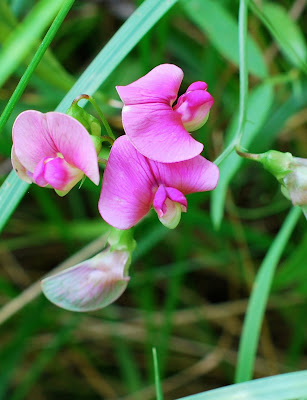
There seemed to be even more wildflowers out than before: striking Goldenrod, starry blue Chicory, small white daisies, little pink Wild Sweet Peas and many more.


A plant of the Salvia family, probably Blue Vervain

A good example of Poison Ivy - don't touch.
Thursday, July 22, 2010
 |  Sponsor of the Week: ExOfficio - See Recent Sponsors |
CATEGORY: Kayaks (Kayaking)
- Naming of Parts�Kayaks by Tamia Nelson
- Folding Kayaks and Canoes by Farwell Forrest
- Inflatable Kayaks and Canoes by Farwell Forrest
- Sit-on-Tops by Farwell Forrest
- Kayak Design and Construction of the Ancient Paddlers by Tom Watson
- Outfitting a Kayak by Farwell Forrest
- Kayak Features by J. Michael Wyatt
- Carrying a Sea Kayak Alone by Wayne Horodowich
- Going Straight - Rudder or Skeg? by Farwell Forrest
- Cockpit Makeover: Do-it-Yourself Outfitting by Scott MacGregor
- Reflections from the Cockpit: Deck Storage by Wayne Horodowich
- Six Steps to Comfort and Control by Scott MacGregor
- Packing for an Overnight Trip by Tim Sprinkle
- Keeping Your Kayak Hull in Tip-top Condition by Tim Sprinkle
- Sea Kayaking's True Colors by Tom Watson
- Why Can't I Do That? by Wayne Horodowich
- Using A Deck Sling by Wayne Horodowich


 Research Kayaks in the
Paddling.net Buyers' Guide
Hike around Westminster Ponds
Another hot and humid day. I drove to Westminster Ponds to join up with the TVTA hikers - and missed them! Had left the house just a bit too late. Still, another hiker had cut it just a bit too tight as well and we set off together into the wilderness of the woods surrounding the ponds. The mosquitos were fierce. Although I had sprayed myself (almost all over) with bug spray, they just loved my hands and face.
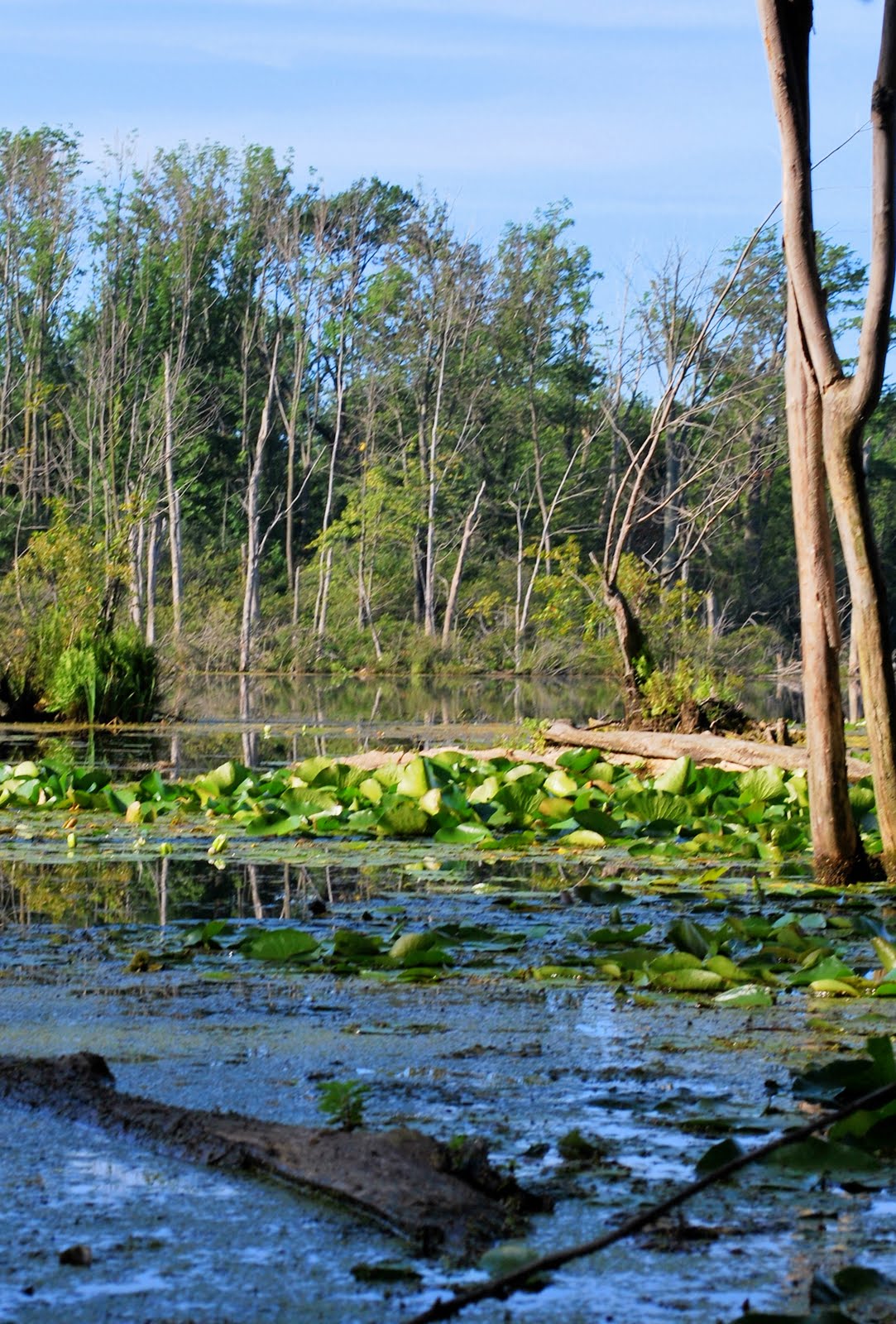
At the water's edge: plenty of lilies floating on the surface.

The emerald lagoon.

The path: at times steep and covered in roots.
I would not say that we were lost - but I certainly did not know where exactly we were, either. Thus when we chanced upon the TVTA hikers somewhere in the woods, there was no question about not joining them. The hike leader knew where the cars were parked!

Back in the safety of the group.
Wednesday, July 21, 2010
Plover Mills to Ebenezer Road
There were six of us today, meeting at Highbury/Huron to carpool further north near Highway 7. We took almost two hours in the heat of the day to cover 4.3 km along Thames River from Plover Mills Rd. to Saunders Auto Parts on Ebenezer Rd.

Tom and a crew of volunteers had cleared the path only yesterday; thus we were able to stroll at our leisure along the corridor hewn into the shoulder-high bush and grassland.


Tom and a crew of volunteers had cleared the path only yesterday; thus we were able to stroll at our leisure along the corridor hewn into the shoulder-high bush and grassland.

This was a varied and enjoyable route: steep woodlands, plenty of wooden bridges, fields and grassland.


View Larger Map

Some tiny fungi in the woods.

Thames River below the woods.

There are plenty of wild flowers out at the moment.
View Larger Map
Saturday, July 17, 2010
Saturday Walk at Medway Creek
By 9am temperatures were already approaching my comfort limit. Thirty walkers met at UWO parking lot to walk past Brescia College into Medway Valley Heritage Forest and back to the cars via Huron College. At 10am it was too hot to enjoy taking another step.


Grain field north of Brescia College.

One of the numerous dead and bleached trees along the field.
Friday, July 16, 2010
Images for kentucky coffee tree
- Report images


The Kentucky Coffeetree, Gymnocladus dioicus, is a tree in the subfamily Caesalpinioideae of the pea family Fabaceae, native to the midwest of North America. The range is limited, occurring from Southern Ontario, Canada and in the United States from Kentucky (where it was first encountered by Europeans) and western Pennsylvania in the east, to Kansas, eastern Nebraska, and southeastern South Dakota in the west, and to northern Louisiana in the south. It was formerly the state tree of Kentucky.
Varies from 18 to 21 meters (60–70 feet) high with a spread of 12–15 meters (40–50 feet) and a trunk up to one meter (3 feet) in diameter. A 10-year-old sapling will stand about 4 meters (13 feet) tall. It usually separates 3 to 4½ meters (10–15 feet) from the ground into three or four divisions which spread slightly and form a narrow pyramidal head; or when crowded by other trees, sending up one tall central branchless shaft to the height of 15–21 m (50–70 ft). Branches stout, pithy, and blunt; roots fibrous.[2]
The Kentucky Coffeetree is a relatively fast-growing tree and generally grows in parks and along city streets for ornamental purposes. The tree is typically long-lived however often appears dead for the first six months of its growth. This is because the Kentucky Coffeetree sheds its leaves early during the late spring and therefore appears bare for up to 6 months. The naked appearance of the tree is reflected through the Kentucky Coffeetrees genus name. (Barnes, Wagner at el. 1977) from Michigan Trees.
Like the Sumac, branches are totally destitute of fine spray; smaller branches are thick, blunt, clumsy and lumpish. While other trees lose their leaves, along their twigs and branchlets are borne the buds, the hope and the promise of the coming year. But the Gymnocladus seems so destitute of these that the French in Canada named it Chicot, the dead tree. Even when spring comes, it gives no apparent recognition of light and warmth until nearly every other tree is in full leaf. The casual observer says it bears no winter buds, but there is a tiny pair, wrapped in down and wool, lying sleeping in the axil of every last year's leaf.[2]
Among the trees of the eastern United States, there are two others with similarly large leaves: the Honey locustDevil's Walking-Stick (Aralia spinosa). The expanding leaves are conspicuous because of the varied colors of the leaflets; the youngest are bright pink, while those which are older vary from green to bronze.[2] (Gleditsia triacanthos) and the

The bark is ash-gray and scaly, flaking similarly to black cherry, but more so. The flowers are dioecious, and the fruit is a hard-shelled bean in heavy, woody, thick-walled pods filled with sweet, thick, gooey pulp. The shape of the pods varies somewhat: pod length ranges from about 12.7 to 25.4 cm; unfertilized female trees may bear miniature seedless pods. The beans contain the toxin cytisine.

- Bark: Dark gray, deeply fissured, surface scaly. Branchlets at first coated with short reddish down.
- Wood: Light brown; heavy, strong, coarse-grained; durable in contact with the ground, takes a fine polish. Sp. gr., 0.6934; weight of cu. ft., 43.21 lb (19.60 kg).
- Winter buds: Minute, depressed in downy cavities of the stem, two in the axil of each leaf, the smaller sterile. Bud scales two, ovate, coated with brown tomentum and growing with the shoot, become orange green, hairy and about one inch long, before they fall.
- Leaves: Alternate, bi-pinnately compound, ten to fourteen pinnate, lowest pinnae reduced to leaflets, the other seven to thirteen foliate. One to three feet long, eighteen to twenty-four inches broad, by the greater development of the upper pairs of pinnae. Leaf stalks and stalks of pinnae, are terete, enlarged at base, smooth when mature, pale green, often purple on the upper side. Leaflets ovate, two to two and one-half inches long, wedge-shaped or irregularly rounded at base, with wavy margin, acute apex. They come out of the bud bright pink, but soon become bronze green, smooth and shining above. When full grown are dark yellow green above, pale green beneath. In autumn turn a bright clear yellow. Stipules leaf-life, lanceolate, serrate, deciduous.
- Flowers: June. Dioecious by abortion, terminal, greenish white. Staminate flowers in a short racemen-like corymb three to four inches (102 mm) long, pistillate flowers in a raceme ten to twelve inches (305 mm) long.
- Calyx: Tubular, hairy, ten-ribbed, five-lobed; lobes valvate in bud, acute, nearly equal.
- Corolla: Petals five, oblong, hairy, spreading or reflexed, imbricate in bud.
- Stamens: Ten, five long and five short, free, included; filaments thread-like; antehrs orange colored, introrse; in the pistillate flower small and sterile.
- Pistil: Ovary superior, sessile, hairy, contracted into a short style, with two stigmatic lobes; ovules in two rows.
- Fruit: Legume, six to ten inches (254 mm) long, one and one-half to two inches wide, somewhat curved, with thickened margins, dark reddish brown with slight glaucous bloom, crowned with remnant of the styles. Stalks and inch or two long. Seeds six to nine, surrounded by a thick layer of dark, sweet pulp.[2]
Taxonomy
Gymnocladus is of Greek derivation and refers to the stout branches destitute of spray.[2]
It is one of three species in the genus Gymnocladus, the other two being native to eastern Asia. These are Chinese Coffeetree Gymnocladus chinensis in central China, and Burmese Coffeetree Gymnocladus burmanicus in Burma.
The name is sometimes hyphenated as 'coffee-tree'; the form 'coffeetree' used here is as used officially by the United States Forest Service.
Distribution
Widely dispersed, but rare.
The Kentucky Coffeetree, Gymnocladus dioicus, is considered a rare tree species. "Rare species are those that are so uncommon that they should be monitored to determine whether their populations are becoming threatened" (Wagner et al. 1977) from Michigan Trees.
The Kentucky Coffeetree is a "species of the midwestern states, reaching its northern limit in Michigan" (Barnes, Wagner et al. 1977) from Michigan Trees.
This tree usually occurs as widely dispersed individuals or small colonial groups with interconnected root systems. This tree is found in floodplains and river valleys but is also sometimes seen on rocky hillsides and limestone woods. In the northeastern part of its range, seemingly natural groves of this tree are actually associated with known prehistoric village sites. In some parts of its range, this tree may be used as an indicator of the presence of limestone or of calcareous soils.
There is a Kentucky coffeetree located at the Wisconsin Welcome Center in Beloit, WI on I-90. There are also some Kentucky Coffee trees on the Mount Vernon estate formerly occupied by General George Washington. Seeds and seed pods may be picked up along the path leading up to the mansion.
Cultivation

Kentucky Coffeetree is easy to grow from seed. Filing the seedcoat by hand with a small file, and then soaking the seeds in water for 24 hours will ensure rapid germination. Propagation is also easy from dormant root cuttings.
It forms large clonal colonies, reproducing by shoots sprouting from roots.
Trees prefer bottom lands, and a rich moist soil.[2] Its growth is largely unaffected by heat, cold, drought, insects, disease, road salt, ice, and alkaline soil.
The Kentucky Coffeehouse is typically found on "alluvial soils of river and flood plains and nearby terraces" (Barnes, Wagner at el. 1977) from Michigan Trees.
Toxicity
Toxic to animals. See veterinary link: http://www.library.uiuc.edu/vex/toxic/kentucky/kentucky.htm
Uses
| “ | When Kentucky was first settled by the adventurous pioneers from the Atlantic states who commenced their career in the primeval wilderness, almost without the necessaries of life, except as they produced them from the fertile soil, they fancied that they had discovered a substitute for coffee in the seeds of this tree; and accordingly the name of Coffee-tree was bestowed upon it. But when communication was established with the sea-ports, they gladly relinquished their Kentucky beverage for the more grateful flavor of the Indian berry; and no use is at present made of it in that manner.[2] | ” |
| —A. J. Downing | ||
In pleasure grounds it is not uncommon, since it is often planted because of its unique appearance and interesting character.[2]
The peculiarly late-emerging and early-dropping leaves, coupled with the fact that the large leaves mean few twigs in the winter profile, make it a tree that is ideal for urban shading where winter sunlight is to be maximized (such as in proximity to solar hot-air systems).
Food
The common name "coffeetree" derives from the use of the roasted seeds as a substitute for coffee in times of poverty. They are a very inferior substitute for real coffee, and caution should be used in trying them as they are poisonous in large quantities.

Closeup of leaves.
Subscribe to:
Posts (Atom)